






By Yvonne Wright • The Current Contributing Writer
When powerful iron-and-steel locomotives began to hurtle across the land in the early 1800s at speeds never experienced before, propelled by their massive steam-and-coal engines that produced impressive amounts of high temperature water vapor shooting out of their chimneys, it was quite a sight to behold – intoxicating to artists, stirring their souls to the depths of their being. As a result of these new sensorial experiences a magnificently creative experimentation in art began to parallel Industrial Age technological progress and social transformations, heralding the arrival of modernity’s avant-garde aesthetics.
North American and European artists found 19th century industrialization rather fascinating; it brought exciting changes, restlessness and new innovations that suited their creative and free-spirited temperaments. The presence of ‘the iron horse’ (as it was first called) fueled an enthusiasm for present-day reality.
By the 1870s, much improved steam-belching locomotives regularly hauled travelers to distant locations, democratizing travel to be no longer exclusive to the upper classes. Faster and more comfortable than horse-driven stagecoaches and reaching a notable 100 mph in passenger service, these early wonder-machines ushered in a new kind of mobility – enabling, for example, a growing number of plein-air painters (artists specializing in depicting the outdoors) to arrive at their favorite destinations with relative ease.
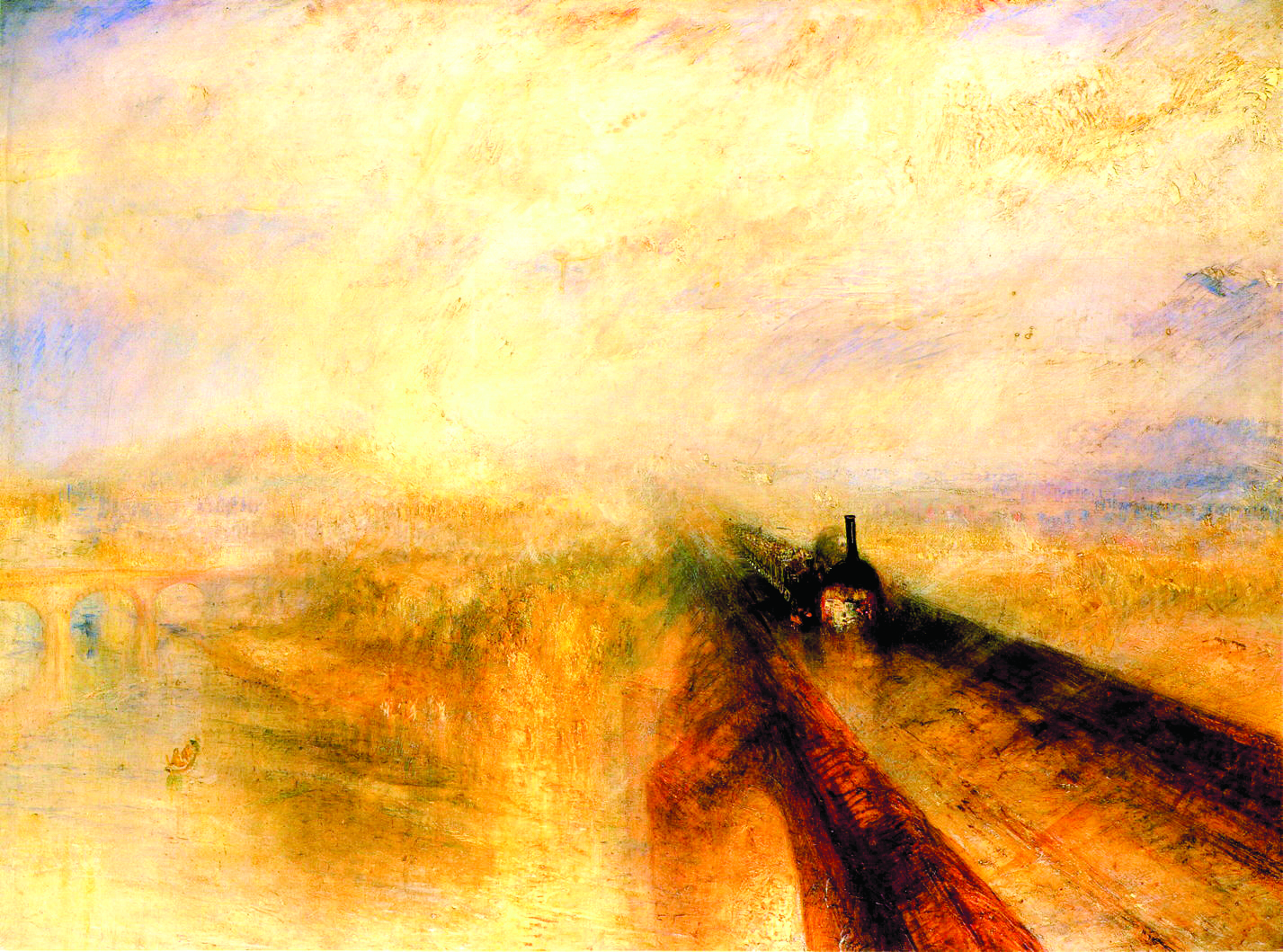
British painter William Turner (1775–1851) was one of the first artists to depict a speeding train passing through a storm-drenched landscape. His 1844 oil on canvas Rain, Steam and Speed – The Great Western Railway is a mastery of light and textures brought to near abstraction. It magnifies the power of the locomotive as a new mechanical wonder, destabilizing the composition as it blasts through the canvas with a barely contained vitality.
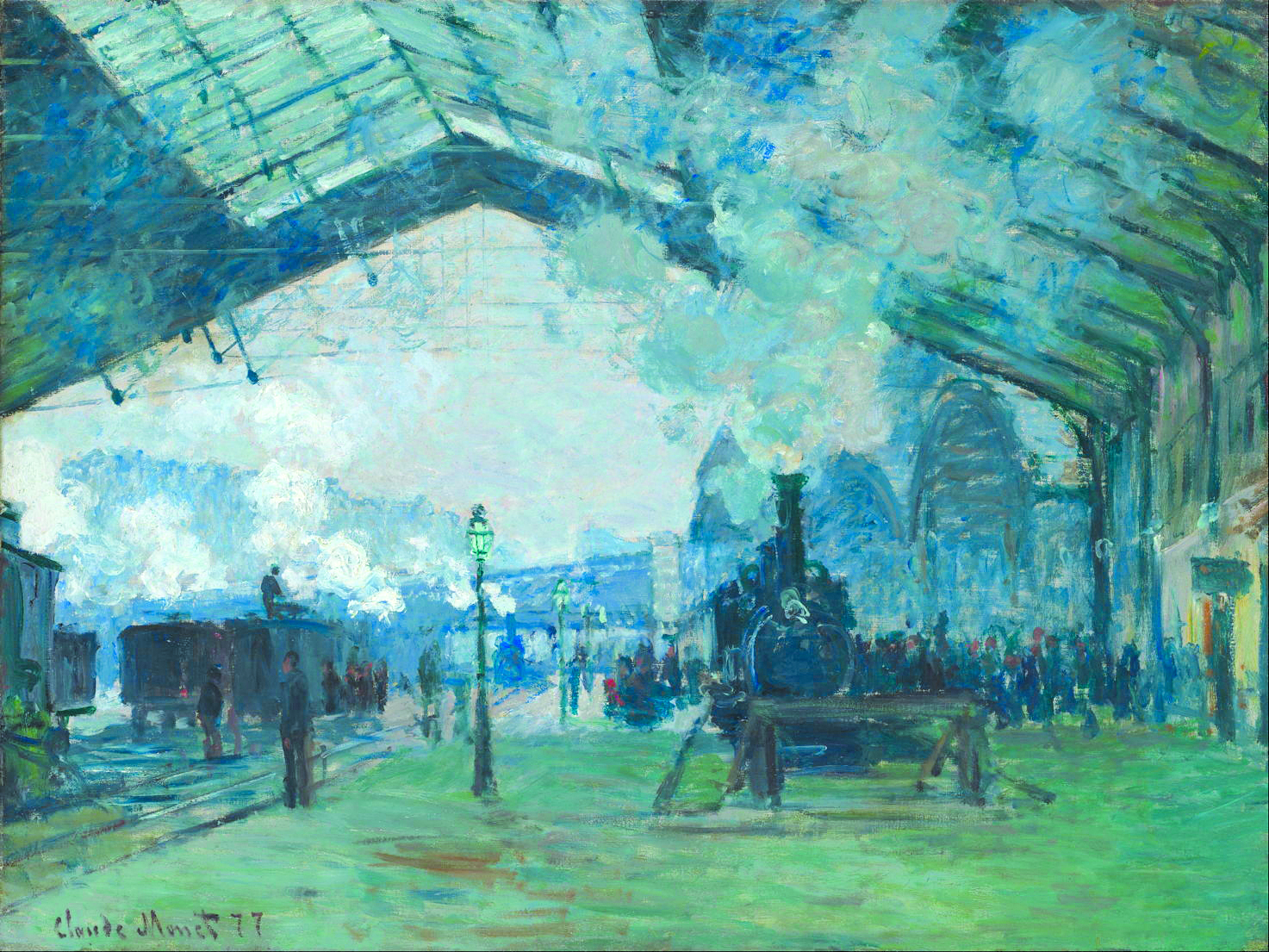
Soon, many other artists followed suit, and began to glorify trains in their art, painting them at various seasons and times of the day. This fascination produced some of the world’s most artistically enduring works of art, depicting bridges, viaducts, terminals and locomotives dotting the landscapes. French Impressionist Claude Monet completed several large paintings based on the Parisian Saint-Lazare Station, masterfully capturing with his brush strokes its chaotic atmosphere and the lingering steam as passengers unloaded.
By the turn of the century, the demand for even more efficient ways of transportation intensified, and many artists were right there at the forefront capturing and glamorizing modern society on the move. In the United States, railroads played a paramount role in the economical development of the nation. From the early industrial revolution in the North-East (1810–1850) to the settlement of the West (1850–1890) the American network of railroads with their massive steam-belching locomotives became the engine that powered, drove and dispersed the national economy and wealth across the continent – connecting large urban centers with small town communities.
By 1910, most of the major cities in the United States proudly flaunted magnificently palatial termina ls serving thousands of travelers – many of which are still in use, or have been renovated and/or repurposed for their cultural significance, such as Penn Station in Midtown Manhattan, and Union Station in Washington D.C. At the height of their popularity, people would dress in their Sunday best to go down to the railroad station to watch the trains come in. Indeed, the invention of trains significantly impacted the way art in its many forms was made and experienced, and a new wave of artists emerged with many creative productions reflecting this new and fast paced technological era.
In the mid-1800s, the United States government commissioned numerous railroad surveys to seek potential routes for the coming transcontinental railroad. American artist and explorer of the West, John Mix Stanley (1814-1872) accompanied one such Pacific Railroad Survey and visually documented the expedition. Today, his images stand as essential firsthand records of the terrain, inhabitants, plants, and wildlife as they were encountered along the way; while his lithographs helped to energize a worldwide fascination with the American West.
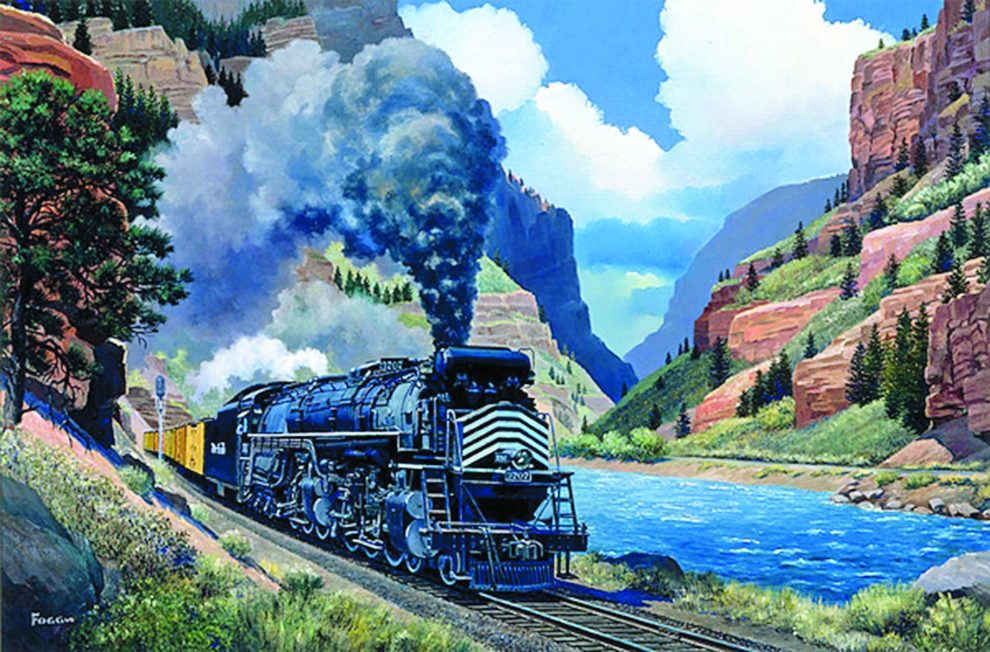
Another American artist, Howard Fogg (1917-1996) expressed his love for the railroads in his large-scale oil paintings, well respected for their outstanding accuracy and realism in depicting details. Depicting various types of locomotives and trains came quite naturally to the artist, whose father held a VP position at the Litchfield & Madison Railroad company (operating 44 miles of track, nicknamed the St. Louis Gateway Route). Due to his love for and knowledge of trains, Fogg is often referred to as the “dean of American railroad artists”
As we are celebrating our Nation’s 250th Birthday, on July 1st the world’s largest and still in operation steam-powered locomotive, fondly called The Big Boy No. 4014, rolls into Jim Thorpe for an overnight stay; the excitement is huge, and the town is bracing for enthusiastic crowds. Thereafter, The Big Boy is scheduled to travel to the American semi-quincentennial ceremonies in Philadelphia. Originally commissioned exclusively for the Union Pacific Railroad (UP), this year The Big Boy is hissing and puffing its way Coast to Coast across America, as part of the UP’s proud American heritage.
Designed by Otto Jabelmann and built in Schenectady NY, in 1941 by the American Locomotive Company (ALCO), the beast’s physical dimensions are impressive: total weight 1,218,500 lbs, 11 ft wide, and approx. 16 ft tall. Assigned to haul heavy freight trains, the No. 4014’s last commercial run was made July 21, 1959 and it cost $4 million US dollars to restore it. There are seven more Big Boys remaining on public display, but they are not operational: one each in Scranton PA, St. Louis MO, Dallas TX, Omaha NE, Denver CO, Green Bay WI, and Cheyenne WY.
Perhaps one of the most exceptional achievements that very impactfully spells out the nation’s proud 250 years of history is a fleet of massive mechanical muscle: steam-and-coal powered, iron-and-steel American made locomotives that cast their shadows now from the pages of history, symbolically honoring their land and the peoples that came before with their powerful traveling ambassador, The Big Boy No. 4014, whose ability to connect people from all walks of life transcends political affiliations and economical divides, providing a glimpse at the past while at the same time telling a story of endurance and defiance in modern day.












Add Comment